Welcome to the very first installment of Amelia Dronehart’s “Share Your Story.” I couldn’t think of a better person to kick things off with than Amy Wiegand. You can also watch the interview on our YouTube channel (please make sure to subscribe).
You may know Amy from her work with DroneUp. She has 30 years of experience consulting for companies that collaborate with some of the world’s biggest brands including Walmart, UPS, and Coca-Cola. She’s also a Pilot Institute expert and has recently launched her own app to tackle a problem I think a lot of us can relate to: How do you price your drone services so you’re actually making a profit?
Amy has spoken at Commercial UAV Expo and has been tapped as an expert for conferences and events across the industry. She’s also an all-around wonderful person.
Her company is Earhart Alden & Associates, and we’re going to find out where that name comes from because there’s a fascinating story behind it.
Let’s get to know more about Amy and what she’s building, both professionally and personally.
K: Welcome, Amy. And thank you for taking time out of your busy schedule to talk with me today.
A: Well, it’s an absolute pleasure, Kara. I’m so happy that you were able to refresh this group, Amelia Dronehart. It’s an excellent opportunity for us to build community. I’m really excited for you. And building community is key, especially since we are 8% women in the industry. Even though I love working with men, it is special to have a place where you can talk with other women, share your experiences, and just kind of feel a little more at home, being vulnerable with some of the challenges and opportunities that you get working in this business.
K: I am eternally grateful to Rhianna for giving me her blessing. And I’m excited to have people like you interested in the group because I think that’s what’s going to help us grow as well. Without further ado, my first question is: You have 30 years in growth, sales and marketing with these big firms. What did you take from your roles doing sales and marketing for Walmart, Coca-Cola? What lessons did you bring into the drone industry?
A: Well, let me just clarify. Walmart, UPS, Coca-Cola, those were customers of companies that I worked with. But the integration into their organizations and their systems and processes was instrumental in my own growth and career. So I’m eternally grateful for that opportunity. I think the thing that folks need to understand is scaling and creating systems and having customer-centric execution is key.
And it doesn’t matter what size org. At those companies I learned that this growth, it’s not accidental. It takes all of those. It takes a team, takes community. And it comes from discipline and consistency and go-to-market alignment, which is really important. A lot of people don’t really know what go-to-market means, but it’s a process and a system within an organization where you take your products and services to the marketplace. That includes having clear value propositions, and defensible pricing — which is super important, especially for drone service providers.
You want to have repeatable processes.
This is where I see the biggest gap and a lot of the mistakes that are being made in the drone service provider community. You want to have repeatable processes. These big orgs really taught me repeatable processes are instrumental, vital, and a relentless focus to the buyer’s actual needs. What does your customer need to solve? What problem do they need to solve? What outcomes are you going to help them with? And there’s, “what’s the value in that?” Technical capabilities alone aren’t enough. They’re not creating revenue. You need market validation. You need cost modeling. We’re going back to that pricing. Professional deliverables.
I see a lot of people ask, “how do I get more customers” and not “what do these customers need? How am I solving a problem?”
So, a system and processes and deliverables that show up as professionally as possible. A pipeline that is honored with discipline and focus so you can bring that enterprise-grade operating discipline to your small startup. Also, and I have to say, cool tech isn’t enough. It’s not a sustainable business proposition.
You really have to understand the problems you solve for the customer. Walmart, UPS and Coca-Cola? They know how to do that really well and taught me a lot there about how to grow in that space. That’s important because I see a lot of people ask, “how do I get more customers” and not “what do these customers need? How am I solving a problem?” I think that’s where a lot of people get tripped up.
K: Your Dad introduced you to flight training. How did that come about?
A: Well, it’s interesting. He was an adventurer and he would race cars. He collected old cars. He would get up in the air in hot air balloons and all kinds of different situations. And so I watched him get into a glider. Actually, my Mom had bought him a gift certificate for a birthday or anniversary. I can’t remember. It’s been a while. I think I was 12.
We went out to the small airport where he was going to take off and be pulled up and float around in the sky. And a really young, vibrant young man came up to my Mom and I and started talking. He said he was a CFI, or a certified flight instructor, there. He said, “hey, you want to hop in an airplane with me?” It just happened to be a Cessna 150. I got in there and I was like, “where can I learn? How can I learn?”
You can start as early or as late as you ever want. It’s never too late.
Quite frankly, it was quite a few years later, I think I was 35, when I started actually taking flight lessons. That’s a whole other story. But without that adventurous spirit of my Dad, I probably wouldn’t have been introduced to the little Cessna opportunity to train. That really started a lot of my interest in aviation and following it, and wanted to learn more about it for a long time.
The means weren’t there for a while. It’s expensive and I was finally able to afford it and started training in my 30s. You can start as early or as late as you ever want. It’s never too late.
K: I always tell people that I didn’t even start in drones until my late 30s. So “just start” is what I say. I think that’s a good lesson I bring into Amelia Dronehart. I don’t need to have this all figured out today. I’m just going to build upon it and learn lessons as I go.
A: Well, there’s so many women, like Vera Wang didn’t design her first dress until she was in her 50s. And Juliet, the lady who started the Girl Scouts, she started the Girl Scouts at 52. So, yeah, it’s never too late.
K: Your firm is called Earhart Alden & Associates. And you are a distant relative of Amelia Earhart. How has being related to her shaped your legacy?
A: So I think it’s an inspirational (story) rather than a defining story for so many of us. Amelia’s courage and curiosity and willingness to push boundaries are valued. And I deliberately carry those knowing that she’s a distant relative, maternal, a great grandmother’s cousin. Naming the firm Earhart Alden & Associates honors that heritage and Earhart for pioneering her pioneering spirit.
Progress requires both bold vision and disciplined execution.
The Aldens, John and Priscilla Alden, came over on the Mayflower. I’m a direct descendant of them, as many, many, many people are. They had 13 kids. Their kids each had 13 kids. It just goes on and on, like Marilyn Monroe. Lots of different people are related to these folks. But I wanted to plug in Alden, since they’re my 13th grade grandparents, for their quiet perseverance of building something bigger than themselves.
I mean, can you imagine how scary it would have been to get on a boat and cross the ocean to come and settle another land? It reminds me daily that progress requires both bold vision and disciplined execution. That’s an inspiration for me, if nothing else.
K: What a cool family tree. That’s all I have to say. Very cool. So, I actually first learned about AeroRev at Commercial UAV Expo, and I’d like to talk about this app you built. Is it with a new pilot in mind or someone already established? Who did you build it for specifically?
A: AeroRev is part of a larger project I’m working on, which will remain confidential. Let’s just tease it out there. But I wanted to do some testing with an AI agent. AI is becoming and has been becoming a very predominant part of our workday. In fact, we’ve been using AI probably a lot longer than people even recognize. But I wanted to be a part of the conversation because of the debate. You know, “is this good for us? Is this a good way to go as we build technology?”

Of course, it offers that faster, maybe better, but I still believe there’s an authority figure that needs to be involved in AI. I want to be a part of that governance and compliance conversation. What I see is a lot of small businesses need help building from scratch. I see founders who have done very successful jobs as engineers, lead developers, technologists, aviators, but they’re getting close to retirement or they want to start a side hustle. And they really don’t know how to operate a small business.
Our go-to-market, for that matter, is two different skills. Then you get the complexities of learning how to fly a drone and learning how to use editing software and all of the hardware and the tools and things that are associated with that. It’s a lot, actually. It’s a lot to be a drone service provider business owner.
So, I thought, okay, what I’m going to do is offer a readiness report? We call that the Discovery Flight, keeping it aviation-centric, free of charge to the drone service provider community. They can go in and they talk to AI. It’s audible. And the reason it’s audible is to make it easy. It doesn’t have to be audible. You can type it in as well. But we wanted to make it easy to use and to interact with as possible.
It’s built in a way that on the back end, I’ve taken my knowledge as a small business owner and a sales and marketing specialist and I’ve put information in there that’s going to help build your readiness report to growing your business and then what those next steps are.
There’s a lot more to pricing than just pulling a number out of a hat or comparing it to Joe Blow on Facebook. Your margins need to be accounted for. Your gross margins, your profit margins, these are two different numbers. You have to understand pricing in order to survive and grow.
Now, on the same token here, it’s super important that this agent understands drone service providers. So Jared Janacek, with Texas Drone Co., has built a very credible drone service operation in which he provides drone services to multi states and those employees. And he has helped build the engine that speaks directly to the drone service provider. Our combined knowledge has built an agent.
It’s in a beta test right now, and we are simply getting people to come and take the discovery flight for free to get that readiness report for their drone business. And I’m going to be frank here. I’m so glad we’re doing that testing because I found the readiness report to be a little lackluster. I want to build upon that.
What Jared and I are doing is we’re taking a look at that, and we’re going to talk to the AI and we’re going to tell it what we want it to do, and code it better, and put some more information in there so that it spits out a report that’s really something you would pay $250 to $500 an hour to receive from somebody that’s a consultant in building businesses.
We want to offer something of value. Then from there, again, it tells the drone service provider what to do. What are the next steps for you? And if you need your website audited, if you really need to dig deep into pricing strategy, we offer some packages and some automation around that. We also plug in ourselves, mainly me, helping walk you through (the process) and making sure that you’re closing the gaps so you can get to profitability faster.
K: Okay, so you’ve answered a lot of my questions just with that last statement, which is wonderful. So what do you mean by defensible pricing?
A: Defensible pricing is pricing that you can stand behind. It’s as simple as that. It’s rooted in real numbers. When you see that on the site, “Defensible Pricing,” it’s fully-loaded costs. It’s competitive benchmarks. It’s the value the client receives. There’s a lot more to pricing than just pulling a number out of a hat or comparing it to Joe Blow on Facebook. Your margins need to be accounted for. Your gross margins, your profit margins, these are two different numbers. You have to understand pricing in order to survive and grow. And it really will help you differentiate yourself.
Most DSPs I see right now are not even covering their costs. And that’s because they don’t understand pricing strategy.
Defensible pricing is transparent enough to explain and consistent enough to scale, and really high enough that you are not subsidizing the client with your own unpaid time or taking on their risk. What does that mean? You show up to a job and you do a job and you think you’re done. And they say, “hey, can you add on inspecting that outbuilding or the maintenance building?”
Well, you don’t have a change order. You didn’t come up with a change order fee. It’s things like that. You have to have defensible pricing built in. You have to cross all your T’s and dot all your I’s with your pricing so you can stand on it and so that you can earn a living and cover your costs. Most DSPs I see right now are not even covering their costs. And that’s because they don’t understand pricing strategy.
K: I totally see that. And so I think that might be more of a newly-certified pilot issue, perhaps? What’s the most common mistake you see with people that just got certificated, got their Part 107?
A: They don’t understand pricing. I also see a lot of folks like leaning into social media too heavily before they’re really credible and they’re doing marketing too early. A lot of people think, “well, if I just do marketing, I’ll get the business.” It’s not true. Marketing is a heavy lift and it’s a cost. It’ll zap your reserves, if you even have any, let alone your energy. I see not understanding pricing, not understanding the market, and then getting into marketing too soon.
K: That’s an interesting perspective. I never thought of it that way. So speaking in general terms of the industry, which drone niches do you think are oversaturated and which ones are most promising for a new operator? I know it kind of varies by region, but is there just a general consensus?
A: I’m of the thought that the drone service providers industries are not oversaturated. What’s oversaturated is drone service providers who do not know what they’re doing when it comes to building a business. They have the technical skills. They have the certification. They can fly. They can work their way around some editing software. Great. You need to have all of those things. But understanding the business side of building a small business is really the differentiator.
The drone service providers industries are not oversaturated. What’s oversaturated is drone service providers who do not know what they’re doing when it comes to building a business.
I encourage people to take a look at really understanding what your customer needs and offering high value. Promising areas, right now, tend to be those with recurring high revenue or data needs, like infrastructure and utility inspections, construction progress, monitoring and mapping, agriculture precision, where the return on investment or their ROI is clear.
Drone service providers really need to understand what the return on investment for their particular client is, whether it’s marketing or real estate, doing golf courses, it doesn’t matter. Oil and gas, it doesn’t matter. Really understanding what your customer needs, what the outcome is, what the return on investment is for them is going to differentiate you.
A lot of folks are going out and charging $60 for something, they’re not even covering their costs and they’re devaluing the industry as a whole.
What we have right now is a commoditization, not an oversaturation. And there’s a little bit of a difference there. A lot of folks are going out and charging $60 for something, they’re not even covering their costs and they’re devaluing the industry as a whole. And if you’re the person who’s watching that and you’re the person who’s doing that, reach out to me. I’ll talk to you free of charge. We can talk about it because what we want to do is elevate the industry. Cream rises to the top.
If you know what you’re doing and you offer that value, you’re going to see a big shift and a difference in the credibility of as a whole. I would encourage folks not to worry about it being oversaturated. Concentrate on your own table and really build your business strong. Differentiate yourself as much as possible. There are ways to do that.
K: I’d love to hear about those ways to differentiate yourself because I also think that people go out and buy all the expensive equipment, but then what’s next?
A: That’s exactly it. And this is what AeroRev is designed to do. It helps you think through all of these different steps. It’s a co-pilot. That’s why we call it a co-pilot. It’s helping you, holding your hand privately in the privacy of your own home, to walk through and really think about how you need to build a small business.
Differentiating yourself? It depends. It’s not a one size fits all. It depends on the industry you’re in. Are you in real estate? Are you going after infrastructure inspection? Are you looking at cinematography? These are very different industries. The way to differentiate yourself is to understand the market you’re serving and then understand that industry, understand the personas and the personas are the people.
Understand that you have a team of people, especially at the enterprise level, that are making these business decisions — from your influencer, and your technical champion, to the person who writes the checks, to procurement, to legal, to compliance. You need to understand who you’re selling to, and how they want to be sold to, and the problems that they need to solve for their companies.
The way to differentiate yourself is to understand the market you’re serving and then understand that industry, understand the personas and the personas are the people.
You can formulate that into really nice conversations, discovery calls with asking the right questions from the very beginning. And then also the packages and your pricing. It really does depend. But differentiators are being educational, being a partner, showing up professionally, looking professional right now. These are some common things, soft skills we need. But, there’s broader differentiators and those certainly depend on your customer.
K: I’m meeting someone at a project site today at 3:00 p.m. and showing up professional is a big part of it. So just being inquisitive, asking the right questions, asking what they need. And this is a new client for me. So this is an exciting challenge today. But yeah, I think you can’t overlook those basic sites. So I was going to ask, so you’ve advised on UTM, which is governing airspace below 400 feet, and also advanced air mobility. So as beyond visual line of sight, I’m just going to spell it out instead of saying BVLOS for people who might not know. As those operations and new rules like FAA’s Part 108 take shape, what kind of changes will they bring on? What will that mean for small business owners? Any opportunities? Any challenges?
A: When regulators are involved, there’s always challenges. But this isn’t new. The airlines have gone through this for decades.The airlines have gone through this for decades. Manufacturing and other industries go through this too. Look at the experts. Watch what they’re talking about. Really immerse yourself in that and understand the regulations. That’s going to set you apart.
Talk about differentiators. You are now an aviator, okay? You’re a technical person. You know how to fly a drone. Your drone is just your tool, so you’re now an aviator. But to get more to your question, these developments expand addressable work. When you’re talking about BVLOS, beyond visual line of sight, and more mature unmanned traffic management, those will open up longer range inspections, which is wonderful.
Linear infrastructure monitoring is going to probably take off a little bit more. And certain delivery or logistics support roles that are currently constrained are going to take off more. And that’s really critical in medical delivery, getting medicines and even organs to people faster is a wonderful thing, responding to emergencies. This is super important.
Small operators who stay current on compliance invest in the right tools. That’s hard to know if you don’t know your market. You got to know your market before you invest a lot of money in your tools. Invest in data workflows and systems and position yourself as a reliable professional partner. You’ll be able to take on these higher value, longer duration missions, so to speak.
Those who mistreat regulations, you’re going to be left behind, right? That’s why it’s important to go to Commercial UAV Expo, and to listen to the Amelia Dronehart podcasts, and to get into the forums and look at Pilot Institute. And there’s so many great resources to ingratiate yourself with and join in community. But those operators who treat themselves as true airspace participants will benefit the most here. Understand that you’re an aviator now.
K: Yes, absolutely. And treat it seriously. So I brought this up a little bit earlier, but there aren’t that many women in the industry. It’s very male dominated. What advice would you give to a woman entering this space?
A: Treat yourself as a professional operator first, really. And a woman second. Everybody always asks me, “what do you want to be seen as?” I want to be seen as an authority. I want to be seen as a source. So, again, master regulations, master the safety culture, FAA (Federal Aviation Administration regulations). You’re an aviator now. Master that safety culture. And then business fundamentals. If you show up with capabilities, it’s a game changer.
I see a lot of folks who are trying, again, going out to marketing too soon, trying to be influencers, Instagram influencers or Facebook famous. It’s really important to have community and it’s glorious to see you putting yourself out there. I love the courage that some of these folks have, but sometimes it’s too soon.
Make sure you’re an authority first before you’re putting yourself out there too soon. Because that does two things. It makes you look like you just want attention. And then it also decreases the value of the industry as a whole. You don’t realize you’re doing that, but you’re contributing, again, to the commoditization of the industry. You’re just one of a lot of people trying to get a small piece of a bigger pie. You don’t want to do that. You want the bigger pie. So become an authority.
Make sure you’re an authority first before you’re putting yourself out there too soon.
I do want to say, I believe community is so important. And I’m building a community as a side hustle myself with something we’ll probably talk about here in a minute. But I also think that you need to get outside of your cliques, especially women. It’s hard for us to walk into a group of men and start having a conversation. Do it anyway. And there’s a lot of organizations that do that. But, get outside of your cliques and expand. Expansion is going to help you become credible. Also, it’s going to be a powerful network because you’re not staying (strictly with your clique). And we’re all, even me, so guilty of staying within our cliques.
We really need to get outside of our cliques, show capability, and still embrace community. All those things can be true at once. And it’s good.
K: There are definitely some women that are doing that who are leading the way. And I would like to ask who has been working in the industry that really inspires you to show up as your best self and be better? Because I could name a few women as well, but I’m curious to see what you think.
So Desi Ekstein is at the top of the list. She’s such a good human being. She shows up for everyone. She extends herself and has extended herself out so gracious and gracefully and professionally. She also belongs to a community. So she’s the perfect example of what I just spoke to. Plus, she knows her stuff. She’s twice published. She’s teaching people. She’s in STEM education.
Dr. La’Quata Sumter is another one. Education is huge and she’s out there doing that. She’s not just talking the talk, she’s walking the walk. And I think those two ladies really need more cred than they get. But everybody that I know in this industry knows those two to be just exactly as I said. They’re good human beings. They have capabilities. They have that authority and they show up for their community and they expand and pull people into that community. It’s amazing. They’re amazing.
K: I could not agree more. I’d add Sharon Rossmark as well. Personally, I think she’s inspired so many of us and actually taught us to be gracious. You want to be around people that lift you up, and also teach you to be a better human being. So those are the people I’ve been surrounding myself with lately. And I think a big part of success in this industry is identifying who does the work, who really uplifts and also maybe who to just keep a distance from as well. I think your success really will come when you surround yourself and look up to people who actually walk the walk and don’t just talk about doing something.
Tell me more about Horizon Flight Center. How do you think it impacted young people?
A: Horizon Flight Center is a business that I ran several years ago. I started flying there as a student and five years went by. Then I applied to actually be their general manager and run the flight center and ran that for several years. One of my jobs as the person who oversaw the flight center was to build programs of value and one of those programs was the Youth Academy.
A very important part of what I do is educating not only adults and founders to build businesses, but showcasing ourselves to kids. And that’s so important, especially to our work in technology. We’ve got to start showcasing ourselves sooner, faster, better. Desi and La’Quata do that so well.
Kids respond to that hands-on possibility more than actually lectures. And so when they get to touch real aircraft or real drones, they start understanding the basic principles of flight.
We volunteered with a lot of different youth organizations at Horizon Flight Center and building the Youth Academy. We ran that for three summers and were very successful. One of my 12-year-olds, at the time, recently graduated from college and is doing really well. He and his Mom still tell the stories of being at the flight center.
Kids respond to that hands-on possibility more than actually lectures. And so when they get to touch real aircraft or real drones, they start understanding the basic principles of flight. It’s super important. It teaches you how to think, walking through this technology and learning how to be a part of something bigger than yourself.
The program reinforced that early positive exposure creates lasting interest, and structured safe experiences are far more powerful than passive observation. I’m a big, big, big champion of STEM education.
K: Me too. And something I saw at UAV Expo too was drone soccer. And I got talking to Tony Reid about that. And he said, this is a way to get kids excited doing something fun and get them curious about the technology. Do you see any gaps in what’s available for getting youth excited about drones? Because as La’Quata has said, there is a gap in the workforce right now. We need to get more young people excited if we’re going to fill that and be sustainable.
A: Yes, I have an answer and it’s multi-layered. There’s a couple things. We need to have the funds to do that. And what we need to do is start educating enterprise so that they understand that if these folks aren’t trained and exposed to this at a young age, they’re not going to have people to do the technology jobs that they need them to do. We need enterprise to get behind our drone service provider community and industry, helping fund programs of education in elementary school, in middle school, in high school, in college.
I sit on the FAA’s, CTI — the college training. And I forget the acronyms. There’s so many acronyms in our industry. But I sit on that and I hear the educators say, there’s no budget. There’s no budget. Some of them have more than others. Good for them. That’s great. Look at getting grants and all of that. But really what I would encourage is enterprise. You need to get involved with these technology organizations, with your community colleges, with your school systems to help fund this exposure to technology.
Beyond that, we need clear pathways to curiosity and competence. Getting a high-quality introduction is important too. The other layer is we need funds to train the trainers. We need to get the adults interested so that they want to train these kids. And, of course, we know a lot of those, Kara, but we need more of them. And so how do we do that?
Unfortunately, everything costs a dime. So we need the folks that have the pockets, who have the philanthropies and the opportunities to either provide grants or donations to really get behind building this workforce pipeline, or they’re going to find out that they’re not going to have a workforce.
K: I agree. And so stepping away from workforce stuff, we are friends on social and I’ve seen quite a bit about Cowgirl Creative lately. I love it. I’m a huge fan of passion projects and stuff that really lights you up. Can you tell me a little bit more about it?
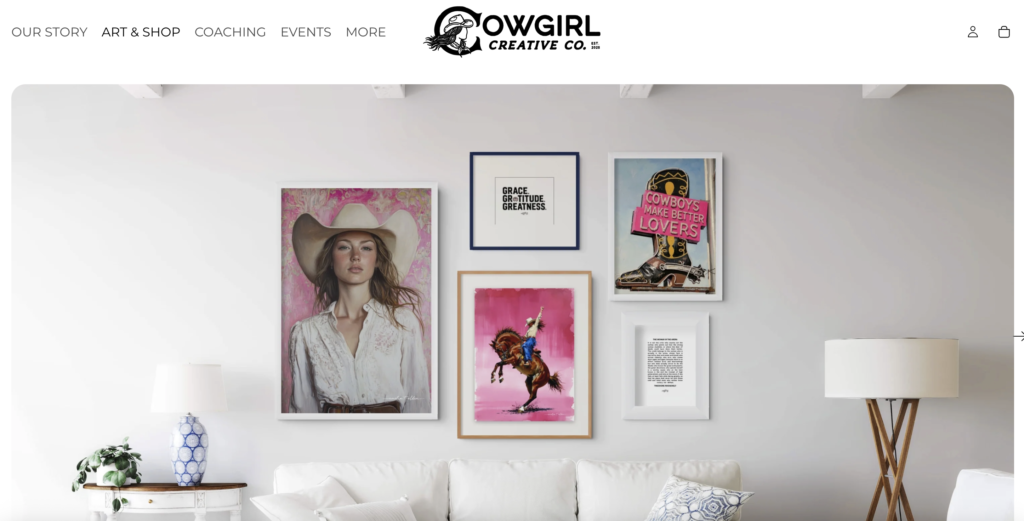
A: Sure, absolutely. Everybody’s got their hobbies. And a lot of people don’t know I have been an artist since I was little. There’s art in my family. I actually owned a graphic design business for four years and sold the assets to that profitably in 2008, of all years. If you know what happened that year, it was a tumultuous year for the market.
As a single mom, I needed to have a bigger girl job. I got involved in some other things through aviation, which I’m grateful for, but have kind of come back into my own, so to speak, and have started doing some drawings. Most of my artwork is digital and I take it and print it off and I’ll do embellishments to it, 3D things, put paint on it, all of that. So, I’m doing some digital art. We call it multimedia art when you add other elements to it.
I’ve got a boutique here in the town I live in that I can sign at, and I’m getting ready for a big festival here in October and doing some really fun stuff around Dolly Parton and memorializing her wonderful spirit. But beyond the art, that’s part of the journey for the Cowgirl Creative Co.
I’m really building a self-love club.
One of the things that I found in my own life through trauma and dysfunction, and learning and unlearning, unlearning is the big thing, is that a lot of how we can grow as individuals, and become who we’re meant to be, and all our potential, is really unlocking our self-love. This isn’t a cliche. It’s a real thing.
I find so many people can’t look in the mirror. I was telling a friend the other day, “do you know 62% of women cannot look in the mirror at themselves?” And I’m not talking about naked. I’m talking about looking at your eyes in the mirror and having a conversation with yourself. And men experience this as well. It’s not isolated to just women. What I’d like to do is create a community that expands the conversation about how we can rebuild our lives through self-love, understanding our worth, and building our confidence when we feel like we just don’t have the energy.
I know if I can do it, anyone can. I’ve been through a lot, and a lot of people don’t know that in this industry. I know that I can share that with others, and I really feel like that’s my side hustle mission and maybe my retirement plan.
K: There is a lot worse you could do for a retirement plan. I think a lot of people can relate to trauma, obstacles, and needing to rebuild that confidence. So that’s a wonderful thing to hear. And you said earlier, reach out to me if you ever have any questions or need anything. And you put that out there for people who might be struggling, either in business and now personally. Where can people find you? Where can they reach out to you?
A: Absolutely. I’m super Google-able. Is that a word? LinkedIn, Amy T. Wiegand. Amy@EarhartAlden.com. They can email me there. But it’s really easy. If you go to LinkedIn, my cover behind my little glamour shot on LinkedIn is my email address and also my phone number. Don’t tell anybody. I’m really easy to find. Probably shouldn’t do that. The IT people and the security people are probably like, why does she do that? But my number’s out there. It’s been out there before I even put it on my cover.
I’m on WhatsApp. You can text me, you can email me, and you can LinkedIn DM me. I’m not as quick on the DMs as I am with an email or a text, but please feel free to reach out. I love meeting new people. I love serving our community and helping where I can.
K: Thank you. Yeah. Well, we’re so lucky to have you.
A: Thank you, Kara. We’re lucky to have you too, lady. Thank you for all you do.
K: I try my best. I think that bringing people together and being supportive is how we definitely move forward. Thank you, again, for your time. I learned so much just sitting here with you for this conversation. And I hope people that read this or watch the podcast get as much out of it. This concludes my first time doing this solo. I have not done a podcast since Pixel Drone Show with Haye and Greg. Thank you, Amy, for being the first to Share Your Story and all that you do for the drone industry.
If you’re in the Waxhaw, North Carolina area, you can view Amy’s sketches and artwork at 88A Boutique on October 10th.